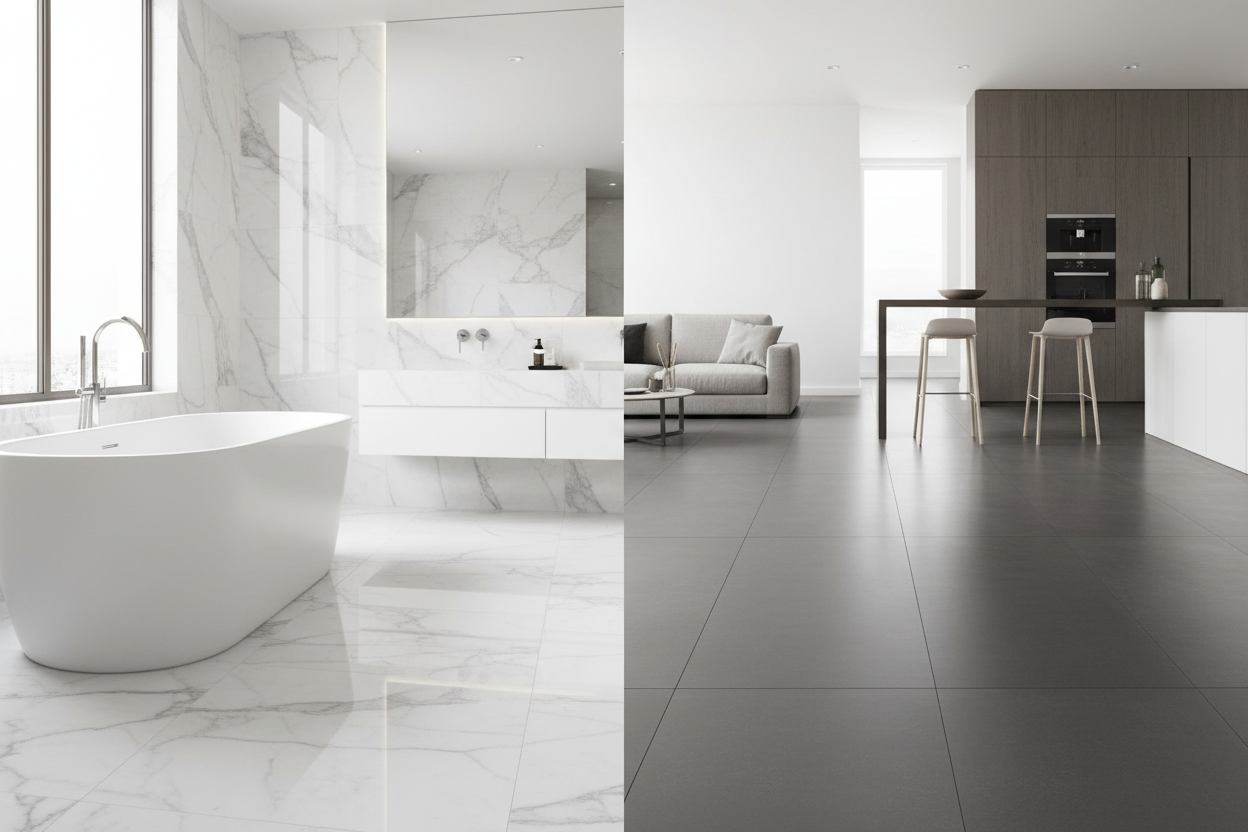
Quick Answer: Porcelain tile wins on durability, water resistance, cost, and low maintenance — the practical choice for busy bathrooms, kitchens, showers, and high-traffic floors. Marble tile wins on natural beauty, uniqueness, and luxury appeal — best for feature walls, statement entryways, and spaces where aesthetics come first. Want marble's look without marble's upkeep? Marble-look porcelain gives you both. Read on for the full comparison, room-by-room verdicts, and real pricing.
In This Guide
- What Is Marble Tile?
- What Is Porcelain Tile?
- Full Comparison at a Glance
- Marble Tile: Pros & Cons
- Porcelain Tile: Pros & Cons
- Cost Breakdown
- Marble vs Porcelain in the Shower
- Marble vs Porcelain for Bathroom Floors
- Marble vs Porcelain for Kitchens
- Marble vs Ceramic Tile
- Room-by-Room Verdict
- Maintenance Tips
- Our Final Verdict
- FAQs
You've narrowed your renovation down to two finalists. Marble vs porcelain tile is one of the most-searched, most-debated material decisions in American home design — and for good reason. Both look stunning in the right photograph. Both can genuinely last for decades. But they behave very differently once real life happens to them: kids running through the bathroom, a dropped bottle of wine on the kitchen floor, a shower used twice a day, every day, for years.
At Tile Hub, we talk homeowners through this exact decision every day. This guide is everything we'd tell you if you called us right now — real cost numbers, honest pros and cons, and a room-by-room breakdown of which material actually performs where you're planning to put it.
What Is Marble Tile?
Marble is a natural stone — a metamorphic rock formed when limestone is exposed to intense heat and pressure deep underground over millions of years. That slow geological process creates marble's signature veining, depth, and color variation. No two marble tiles are ever truly identical; every piece carries its own pattern that no manufactured product can fully copy.
Marble has been the material of choice for palaces, cathedrals, and landmark architecture for centuries — the Taj Mahal, the Lincoln Memorial, and the Washington Monument were all built with it. In American homes today, it remains the go-to for luxury bathrooms, entryways, and statement walls.
Popular marble varieties for tile use in the US include:
- Carrara marble — soft white or blue-gray background with fine, feathery grey veining; the most widely used marble in American bathrooms.
- Calacatta marble — whiter background, bolder gold or grey veining; rarer and pricier than Carrara.
- Statuario marble — pure white with striking dark veining; the most prestigious Italian marble.
- Nero Marquina — dramatic black marble with white veining; striking on feature walls.
- Bianco Dolomite — crisp white with soft grey veining; a favorite for bathrooms and shower walls.
On the Mohs hardness scale, marble scores roughly 3 to 4 out of 10 — softer than most manufactured tile. That softness is part of what gives marble its warmth, and exactly what makes it vulnerable to scratching and etching without proper care.
What Is Porcelain Tile? The Workhorse of Modern Design
Porcelain tile is manufactured, not quarried. It starts as refined kaolin clay blended with feldspar, silica, and other minerals, then fired in kilns at temperatures up to 2,500°F. That extreme heat produces a tile that's exceptionally dense, nearly impervious to moisture, and remarkably hard.
Porcelain sits at 7 to 8 on the Mohs hardness scale — harder than marble, harder than granite, harder than most natural stone used in residential flooring. Its water absorption rate is under 0.5%, earning it an "impervious" ANSI classification and explaining why it consistently outperforms natural stone in wet environments.
What's changed the game over the past decade is digital printing. High-definition inkjet technology now lets porcelain replicate marble, travertine, concrete, and wood grain with accuracy that genuinely surprises people in a showroom — you can find porcelain today that's difficult to tell apart from real Calacatta marble, at a fraction of the price and with none of the sealing schedule.
Porcelain is rated on the PEI (Porcelain Enamel Institute) scale, from Class 0 (wall-only) to Class 5 (heaviest commercial traffic). For most home floors, look for Class 3 or higher.
Marble vs Porcelain Tile: Full Comparison at a Glance
| Factor | 🪨 Marble Tile | ⬛ Porcelain Tile | Winner |
|---|---|---|---|
| Material origin | Natural stone | Manufactured ceramic | — |
| Mohs hardness | 3–4 / 10 | 7–8 / 10 | Porcelain |
| Water absorption | 0.5%–2% (porous) | Under 0.5% (impervious) | Porcelain |
| Material cost | $25–$50+ / sq ft | $10–$25 / sq ft | Porcelain |
| Installed cost | $40–$100+ / sq ft | $18–$32 / sq ft | Porcelain |
| Natural beauty | Unmatched, unique per tile | Excellent (replicated) | Marble |
| Maintenance | High — seal 1–2x/year | Low — wipe clean | Porcelain |
| Scratch resistance | Low | Very high | Porcelain |
| Etching risk | High, from acidic liquids | None | Porcelain |
| Lifespan | 20–50 years with care | 50+ years | Porcelain |
| Resale ROI | Below 50% | Roughly 55% | Porcelain |
| Outdoor use | Not recommended | Excellent | Porcelain |
Marble Tile: Full Pros and Cons
Marble has earned its reputation over thousands of years — but it also asks something of you in return. Here's the honest picture.
✅ Marble Pros
- Unmatched natural beauty — every tile is one-of-a-kind
- Timeless luxury appeal in bathrooms and entryways
- Lasts 20–50 years with proper care
- Naturally heat resistant, stays cool underfoot
- Elevates perceived value in luxury markets
- Natural, quarried material — no chemical processing
❌ Marble Cons
- Expensive — $40–$100+/sq ft installed
- Porous — needs sealing 1–2x per year
- Etches easily from acidic spills
- Scratches in high-traffic areas
- Slippery when wet and polished
- Below-50% resale ROI
- Heavy — needs a checked substrate
Porcelain Tile: Full Pros and Cons
Porcelain is the most popular tile material in American homes for a reason — it's built for real life, not just for photographs.
✅ Porcelain Pros
- Extremely durable, fired at up to 2,500°F
- Nearly impervious to water (<0.5% absorption)
- Very low maintenance — no annual sealing
- Convincingly replicates marble, wood, stone
- More affordable, $18–$32/sq ft installed
- 50+ year lifespan
- Safer in wet areas with textured finishes
- Suitable for outdoor use
❌ Porcelain Cons
- Less natural character than real stone
- Harder to cut — pro install recommended
- Can feel cold underfoot without radiant heat
- Large formats are still heavy
- Lower prestige in ultra-luxury markets
60% of US home shoppers rate high-durability materials like porcelain as "essential or desirable" when shopping for a home (Southeastern Tile Connection, 2025 Buyer Survey).
Marble vs Porcelain Tile Cost: A Realistic Breakdown
Yes, marble is meaningfully more expensive than porcelain — and the gap is bigger than most people expect going in.
| Cost Factor | 🪨 Marble Tile | ⬛ Porcelain Tile |
|---|---|---|
| Material only | $25–$50+ / sq ft | $10–$25 / sq ft |
| Professional installation | $15–$50 / sq ft | $8–$15 / sq ft |
| Total installed cost | $40–$100+ / sq ft | $18–$32 / sq ft |
| 100 sq ft bathroom, total | $4,000–$10,000+ | $1,800–$3,200 |
| Annual sealing cost | $50–$200/year | $0 |
| Resale ROI | Below 50% | Roughly 55% |
Is marble tile more expensive than porcelain? Yes, consistently, at every stage of ownership — upfront material and labor, ongoing sealing, and any future repair from etching or staining. Porcelain's lower purchase price plus near-zero maintenance makes the ten-year cost picture even more lopsided in its favor.
Marble vs Porcelain Tile in the Shower
A shower has three zones — walls, floor, and niche — and they don't need to match.
Marble on shower walls is one of the most beautiful tile applications there is. Polished Calacatta or Carrara, with a penetrating sealant and stone-safe cleaners, holds up well since walls don't pool water the way floors do.
Marble on shower floors is different. Use honed or tumbled marble only, never polished, on a wet floor. Even honed marble is more slip-prone than textured porcelain — a marble mosaic format, with extra grout lines for grip, is the safer way to get the look.
Porcelain in the shower, top to bottom, is the technically superior choice: non-porous, mold-resistant, available in slip-resistant textured finishes, and it asks nothing of you beyond a normal clean.
Our take: porcelain floor, marble (or marble-look) accent wall — you get the visual drama with none of the slip risk underfoot.
Marble vs Porcelain Tile for Bathroom Floors
Is marble good for bathroom floors? Yes, with conditions. It works well in a primary bathroom with low daily traffic, where you're genuinely willing to reseal annually and stick to pH-neutral cleaners. In a busy family bathroom with kids and pets, porcelain is the more practical call — no sealing schedule, no etching risk, better slip resistance.
If you choose marble for a bathroom floor:
- Choose honed, not polished, for better slip resistance
- Seal before grouting, then reseal annually (twice yearly in high-moisture rooms)
- Skip anything acidic — no vinegar, lemon, or bleach-based cleaners
- Use bath mats near the tub and shower entry
Marble vs Porcelain Tile for Kitchens
Kitchens are hostile territory for marble. Acidic foods — lemon juice, tomato sauce, wine — etch marble on contact, and high-traffic zones near the sink and stove show wear faster than anywhere else in the house. Porcelain shrugs off spills with zero absorption risk and survives decades of foot traffic.
Marble for a kitchen backsplash is more defensible, since backsplashes take far less abuse than floors — with good sealing habits, it's manageable, and the veining at close range does something porcelain still can't fully match.
Marble vs Ceramic Tile
Ceramic is the budget-friendly third option a lot of homeowners are weighing alongside marble and porcelain. It's made from similar clay but fired at lower temperatures, so it absorbs more moisture and runs softer than porcelain — but at $3–$12/sq ft, it's the most affordable of the three and genuinely DIY-friendly.
| Factor | 🪨 Marble | ⬛ Porcelain | 🔶 Ceramic |
|---|---|---|---|
| Cost (material) | $25–$50+/sqft | $10–$25/sqft | $3–$12/sqft |
| Water resistance | Low | Excellent | Good (glazed) |
| Best for | Feature walls, luxury baths | Floors, showers, outdoors | Walls, budget renos |
| DIY friendly | No | Mostly pro | Yes |
Room-by-Room Verdict
| Your Situation | Recommendation | Why |
|---|---|---|
| Busy family bathroom | Porcelain | Durability, zero maintenance |
| Master bath / spa retreat | Marble or marble-look porcelain | Luxury achievable either way |
| Shower floor | Porcelain (textured) | Slip resistance, non-porous |
| Kitchen floor | Porcelain | Acid resistance is essential |
| Grand entryway | Marble | Ideal setting for natural drama |
| Outdoor patio/pool deck | Porcelain | Marble deteriorates outdoors |
| Budget full renovation | Porcelain | 2–4x lower installed cost |
Care and Maintenance: Keeping Either Material Looking New
🪨 For Marble Owners
- Seal before grouting, and 1–2x per year after
- Use only pH-neutral cleaners — never vinegar, lemon, or bleach
- Wipe spills immediately — acids etch in seconds
- Use bath mats and felt furniture pads
- Choose honed finish for floors
⬛ For Porcelain Owners
- Seal the grout, not the tile
- Use a pH-neutral cleaner
- Verify subfloor is flat for large-format tile
- Choose matte/textured finish for floors
- Large formats need professional installation
Our Final Verdict
If you have a busy household, kids, or pets, and you want a tile that still looks its best in ten years without annual maintenance appointments — choose porcelain. Modern marble-look porcelain is genuinely convincing, durable, and low-maintenance.
If you're designing a space where beauty is the primary goal, you're committed to proper care, and you want something truly irreplaceable — choose marble. Done right, it's one of the most satisfying materials in any home.
And if you love the look of marble but live the kind of life that makes marble care unrealistic — which is most of us — marble-look porcelain isn't a compromise. It's the right answer.
Frequently Asked Questions
Which is better — marble or porcelain tile?
Neither is universally "better" — it depends on where you're installing it. Porcelain is more durable, water-resistant, and affordable. Marble is more beautiful in a natural, irreplaceable way. For high-traffic floors, showers, and kitchens, porcelain wins. For statement walls and grand entryways, marble is unmatched.
Is marble good for bathroom floors?
Yes, with conditions — in low-to-moderate traffic bathrooms, using honed (not polished) marble, sealed before installation and annually thereafter, with only pH-neutral cleaners. For family bathrooms with heavy daily use, porcelain is the more practical choice.
How expensive is marble tile compared to porcelain?
Marble runs $25–$50+/sq ft in materials versus $10–$25 for porcelain, with installed costs of $40–$100+ versus $18–$32. A 100 sq ft bathroom in marble can cost $4,000–$10,000+ versus $1,800–$3,200 in porcelain.
Can you use marble tile in a shower?
Yes — marble on shower walls is a classic, beautiful choice when properly sealed and maintained. For shower floors, use only honed or textured marble, never polished, or use it in a mosaic format where grout lines add grip.
What is etching on marble and how do you prevent it?
Etching is a chemical reaction between acidic substances (lemon, vinegar, wine, some cleaners) and marble's calcium carbonate surface, leaving a dull mark in the polish. Prevent it by wiping spills immediately and using only pH-neutral cleaning products.
Is porcelain tile that looks like marble worth buying?
Absolutely, for most homeowners. Modern digital printing produces porcelain that's genuinely difficult to distinguish from natural marble, at 50–70% lower cost, with no sealing and better durability in wet or high-traffic areas.
How often does marble tile need to be sealed?
Floor marble should be sealed before installation and resealed annually — sometimes twice a year in high-moisture areas like shower floors. Wall marble in low-moisture rooms can often stretch to every 18–24 months.
We believe every homeowner deserves to see — and feel — the actual tile before deciding. That's why we make it easy to order samples and compare marble and porcelain side by side in your own lighting, before you commit.