Quick Answer
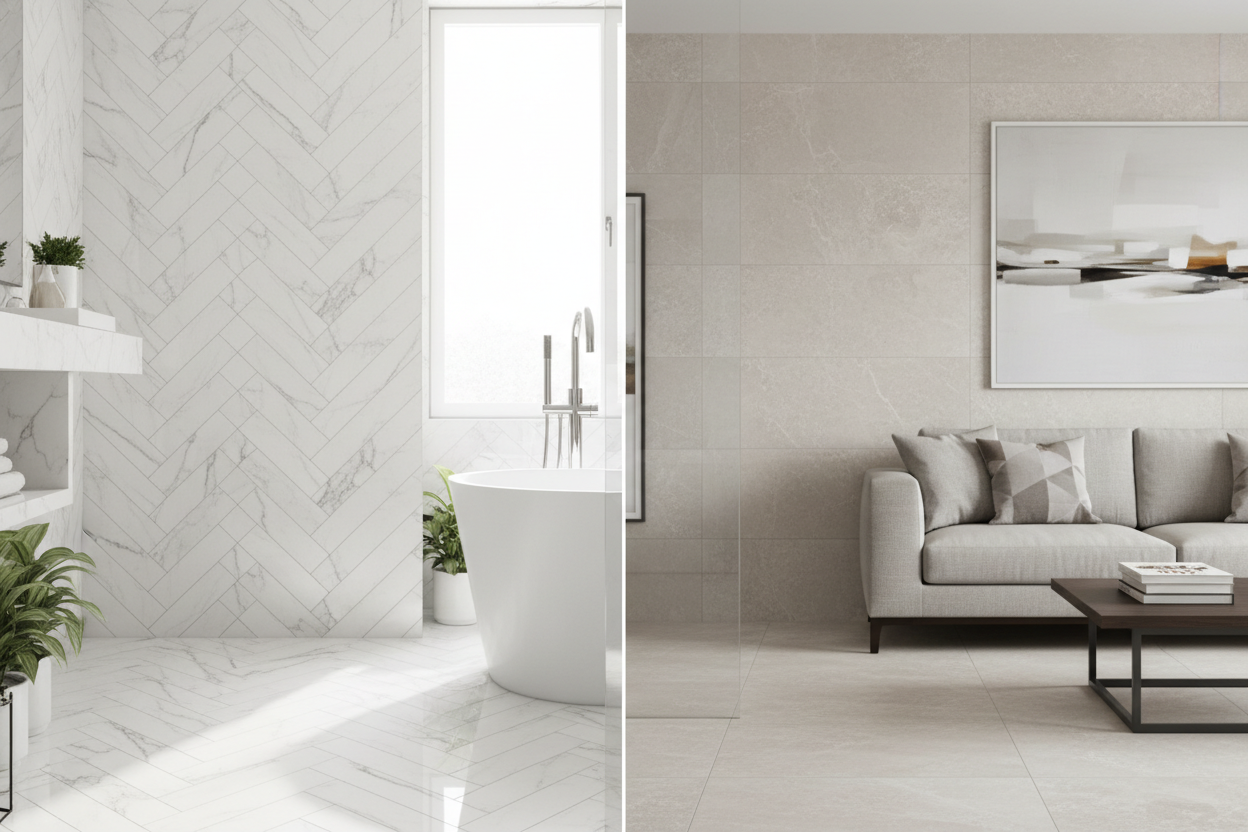
Porcelain tile wins on durability, water resistance, cost, and low maintenance — making it the practical choice for busy bathrooms, kitchens, and high-traffic floors. Marble tile wins on natural beauty, uniqueness, and luxury appeal — ideal for feature walls, spa-like bathrooms, and spaces where aesthetics take priority. If you want the look of marble without the upkeep, marble-look porcelain offers the best of both worlds. Read the full guide to find what's right for your specific space.
You've narrowed it down to two. Marble vs porcelain tile — two of the most searched, most debated material decisions in American home design. Both look stunning in the right space. Both can hold their value for decades. But they perform very differently in real-world conditions, cost differently, and ask very different things of you as a homeowner.
At TileHub, we've helped thousands of US homeowners navigate exactly this decision — and the truth is, there's no single right answer. The "right" tile depends on your bathroom, your lifestyle, and your budget. What we can give you is everything you need to decide with confidence: real cost data, durability science, honest pros and cons, and a room-by-room guide that tells you which material actually performs in each specific setting.
Let's get into it.
What Is Marble Tile? (And Why People Love It)
Marble is a natural metamorphic rock — formed when limestone is exposed to intense heat and pressure deep within the earth over millions of years. That geological process creates the characteristic veining, depth, and variation that makes marble instantly recognizable and inherently luxurious. No two marble tiles are identical. Every piece carries its own unique pattern — something no manufactured tile can fully replicate.
Marble has been the material of choice for palaces, cathedrals, and landmark architecture for centuries. The Taj Mahal, the Lincoln Memorial, the Washington Monument — all built with marble. In American homes today, it remains the gold standard for luxury bathrooms, entryways, and statement walls.
The most popular marble varieties for tile use in the US include:
- Carrara marble — soft white or blue-gray background with subtle, feathery grey veining. The most widely used marble in American bathrooms.
- Calacatta marble — whiter background with bolder, more dramatic gold or grey veining. More rare and more expensive than Carrara.
- Statuario marble — pure white with striking dark grey veining. Considered the most prestigious Italian marble.
- Nero Marquina — dramatic black marble with white veining. Striking for feature walls and flooring accents.
- Bianco Dolomite — crisp white with soft grey veining. A TileHub favorite for bathrooms and shower walls.
On the Mohs hardness scale, marble scores a 3 to 4 out of 10 — softer than most manufactured tiles, which makes it beautiful but vulnerable to scratching and etching if not properly cared for.
What Is Porcelain Tile? The Workhorse of Modern Design
Porcelain tile is a manufactured ceramic product — made from refined kaolin clay mixed with feldspar, silica, and other minerals, then fired in kilns at temperatures up to 2,500°F. That extreme heat creates a tile that is extraordinarily dense, near-impervious to moisture, and exceptionally hard.
Porcelain sits at a 7 to 8 on the Mohs hardness scale — harder than marble, harder than granite, and harder than most natural stones used in residential tile. Its water absorption rate is less than 0.5%, which is why it's classified as "impervious" by ANSI standards and why it outperforms every natural stone in wet environments.
What's changed the game for porcelain in recent years is the technology. Digital printing now allows porcelain to replicate the look of marble, travertine, concrete, wood, and limestone with remarkable accuracy. You can now walk into a showroom and find a porcelain tile that looks virtually indistinguishable from genuine Calacatta marble — at a fraction of the cost and with none of the maintenance demands.
Porcelain tile is rated using the PEI (Porcelain Enamel Institute) scale, which classifies tiles from Class 0 (wall use only) to Class 5 (heaviest commercial traffic). For most home floors, you want Class 3 or higher.
Marble vs Porcelain Tile: Full Comparison at a Glance
| Factor | 🪨 Marble Tile | ⬛ Porcelain Tile | Winner |
|---|---|---|---|
| Material origin | Natural stone | Manufactured ceramic | — |
| Mohs hardness | 3–4 / 10 | 7–8 / 10 | Porcelain |
| Water absorption | 0.5%–2% (porous) | <0.5% (impervious) | Porcelain |
| Material cost | $25–$50+ / sq ft | $10–$25 / sq ft | Porcelain |
| Installed cost | $40–$100+ / sq ft | $18–$32 / sq ft | Porcelain |
| Natural beauty | Unmatched — unique each tile | Excellent (replicated) | Marble |
| Maintenance | High — seal 1–2x/year | Low — wipe clean | Porcelain |
| Scratch resistance | Low — scratches easily | Very high | Porcelain |
| Etching risk | High — acidic liquids damage | None | Porcelain |
| Lifespan | 20–50 years (with care) | 50+ years | Porcelain |
| Resale ROI | <50% | ~55% | Porcelain |
| Luxury perception | Unmatched | Good (marble-look) | Marble |
| Outdoor use | Not recommended | Excellent | Porcelain |
| Design variety | Limited to quarry supply | Virtually unlimited | Porcelain |
Marble Tile: Full Pros and Cons
Marble has earned its reputation over thousands of years. But it also asks a lot of you. Here's the honest picture — every strength and every limitation — so you know exactly what you're committing to.
✅ Marble Tile Pros
- Unmatched natural beauty. The swirling veins, depth, and variation in real marble are impossible to replicate with complete accuracy in any manufactured product. Every tile is one-of-a-kind.
- Timeless luxury appeal. Marble has been synonymous with sophistication for centuries. In luxury markets, genuine marble tile in a master bathroom or entryway signals real quality to buyers and guests.
- Longevity when maintained. With proper sealing and care, marble tile can last 20 to 50 years — a genuine multi-decade investment (Angi, 2026).
- Heat resistant. Marble stays naturally cool and handles heat well — a bonus in kitchens and sun-exposed entryways.
- Raises perceived home value. In high-end markets, genuine marble in a bathroom or kitchen elevates the perceived quality of the entire property during showings.
- Natural and sustainable. Marble is quarried from the earth with no chemical manufacturing process — an environmental consideration for eco-conscious homeowners.
❌ Marble Tile Cons
- Expensive — both material and installation. Marble tile materials run $25–$50+ per square foot, with professional installation adding another $15–$50/sqft depending on complexity. A bathroom renovation can easily run $5,000–$15,000+ for marble alone.
- Porous — requires regular sealing. Marble must be sealed during installation and resealed once or twice a year. Without sealing, it absorbs spills, moisture, and staining agents rapidly.
- Etches easily. Etching is a chemical reaction that occurs when acidic substances (lemon juice, vinegar, some cleaning products, wine, coffee) contact marble's calcium carbonate surface. The result is a dull mark in the polish that is difficult to remove. This is separate from staining — it's surface damage at the molecular level.
- Scratches in high-traffic areas. With a Mohs hardness of 3–4, marble scratches more easily than porcelain. On floors with heavy foot traffic, scratching and wear become visible over time.
- Slippery when wet and polished. Polished marble floors are genuinely slippery when wet — a serious safety concern in showers and wet bathrooms. Honed or textured marble finishes are safer but require even more careful maintenance.
- Low resale ROI. Despite its luxury reputation, marble's ROI at resale is typically below 50% because buyers factor in the maintenance demands and risk of etching or staining (House Digest, 2024).
- Heavy — needs proper substrate. Marble is significantly heavier than porcelain. Floors must be structurally sound to support the load, particularly in older homes.
Porcelain Tile: Full Pros and Cons
Porcelain is the most popular tile material in American homes for good reason — it's built to handle real life. Here's the complete picture.
✅ Porcelain Tile Pros
- Extremely durable. Fired at up to 2,500°F, porcelain is one of the hardest flooring materials available. It resists scratching, chipping, and heavy impact that would damage marble.
- Near-impervious to water. Water absorption below 0.5% makes porcelain the go-to material for showers, bathroom floors, and outdoor use. No etching, no moisture damage, no mold risk from water penetration.
- Very low maintenance. Regular cleaning with warm water and a mild pH-neutral cleaner is all that's needed. No annual sealing. No specialist cleaning products required.
- Incredible design versatility. Modern porcelain can convincingly replicate marble, wood, concrete, travertine, slate, and virtually any natural material — giving you complete design freedom regardless of budget.
- More affordable. At $10–$25 per sq ft for materials and $18–$32 per sq ft installed, porcelain costs significantly less than marble while delivering superior technical performance.
- Longer lifespan. With proper installation, quality porcelain tile can last 50+ years — and because it doesn't etch, scratch, or require resealing, it maintains its original appearance far longer than marble.
- Safer in wet areas. Textured and matte-finish porcelain tiles provide strong slip resistance in showers and bathroom floors — a significant safety advantage over polished marble.
- Suitable for outdoor use. Frost-rated porcelain handles temperature extremes, UV exposure, and weather cycles that would deteriorate marble rapidly outdoors.
❌ Porcelain Tile Cons
- Less natural character. Even the best marble-look porcelain tiles repeat their patterns across the installation. Under close inspection — or simply over time — a trained eye can spot the manufactured regularity that genuine marble never has.
- Harder to cut and install. Porcelain's hardness that makes it so durable also makes it more difficult to cut. Professional installation is recommended, particularly for complex layouts, large formats, or tight cuts around fixtures.
- Can feel cold underfoot. Porcelain is a poor heat conductor — it gets cold in winter. This is addressed easily with underfloor radiant heating, but it's a consideration in colder climates.
- Heavier than ceramic. While less heavy than marble, large-format porcelain tiles are still substantial, and subfloor structural integrity should be verified before installation.
- Lower prestige perception in luxury markets. In very high-end homes, genuine marble is still considered a statement material that porcelain — however convincing — doesn't fully replicate in perceived value.
60% of US home shoppers
rate high-durability materials like porcelain as "essential or desirable" when shopping for a home — Southeastern Tile Connection, 2025 Buyer Survey
Marble vs Porcelain Tile Cost: Are Marble Floors Expensive?
Yes — and the gap is larger than most people expect. Here's a realistic breakdown based on current US market data.
| Cost Factor | 🪨 Marble Tile | ⬛ Porcelain Tile |
|---|---|---|
| Material only | $25–$50+ per sq ft | $10–$25 per sq ft |
| Professional installation | $15–$50 per sq ft | $8–$15 per sq ft |
| Total installed cost | $40–$100+ per sq ft | $18–$32 per sq ft |
| 100 sq ft bathroom (total) | $4,000–$10,000+ | $1,800–$3,200 |
| Annual sealing cost | $50–$200/year (DIY or pro) | $0 |
| Resale ROI | Below 50% | ~55% |
💡 The Maintenance Cost Reality
Over a 10-year period, marble tile's total cost of ownership is considerably higher than porcelain — not just in upfront spend, but in ongoing sealing, professional polishing, and the risk of etching or staining that requires professional restoration. Porcelain's lower upfront cost plus zero maintenance overhead makes the long-term financial case straightforward for most homeowners.
Marble vs Porcelain Tile: Room-by-Room Guide
Where you're installing the tile matters as much as the tile itself. Here's the honest verdict for every major application.
🚿 Bathroom Floor & Shower — Is Marble Good for Bathroom Floors?
This is the most-searched question in this entire topic — and the answer is nuanced. Yes, marble can work in bathrooms. But it demands specific conditions to perform well and last.
In a primary bathroom with low daily traffic where aesthetics are the priority and you're committed to annual sealing and marble-safe cleaning products, marble delivers an unmatched spa-like experience. The cool, smooth surface, the natural veining, the way light moves across it — nothing manufactured replicates it completely.
In a high-traffic family bathroom with children, pets, and daily heavy use, marble is a harder case to make. The ongoing sealing requirements, the etching risk from shampoo and soap products, and the slip risk from polished marble on wet floors are real considerations that porcelain eliminates entirely.
🚿 Marble vs Porcelain Tile in Shower: Key Differences
- Marble in shower walls: Stunning — polished Calacatta or Carrara on shower walls is genuinely one of the most beautiful tile applications possible. Use a penetrating sealant and stone-safe, pH-neutral cleaners only. Avoid any acidic shower products directly on the stone.
- Marble on shower floors: Use honed or tumbled marble only — never polished marble on a wet floor. Even honed marble is more slippery than textured porcelain. Consider smaller tiles (mosaic format) where grout lines provide extra grip.
- Porcelain in shower: The technically superior choice. Non-porous, mold-resistant, textured for slip resistance, and requires only standard cleaning. Marble-look porcelain gives you the spa aesthetic with none of the shower-specific risks.
- Verdict for showers: For shower floors especially, porcelain wins on safety and longevity. For shower walls, either can work beautifully — marble requires more commitment, porcelain delivers peace of mind.
At TileHub, we carry a curated marble collection specifically suited to bathroom applications — including our Bianco Dolomite, Calacatta Marble Mosaic, and Milas Lilac — each sealed and ready for wet-area installation. Our porcelain tile collection includes marble-look options that are indistinguishable from the real thing in photographs.
🍳 Kitchen Floor, Backsplash & Countertops
The kitchen is where the marble vs porcelain decision becomes particularly clear-cut — and where most designers will quietly advise you toward porcelain.
Kitchen environments are hostile to marble. Acidic foods (lemon juice, tomato sauce, vinegar, wine) cause etching on contact. Cooking oils penetrate unsealed marble rapidly. High-traffic floor areas show wear, scratching, and dulling faster than in any other room. And the repeated cleaning with household products — even mild ones — can degrade marble's sealed surface over time.
Porcelain for kitchen floors is genuinely excellent. It handles spills instantly with no absorption risk, survives decades of foot traffic, and can be found in tile formats that mimic natural stone or wood convincingly enough that most guests won't know the difference.
Marble for kitchen backsplashes — this is a more defensible choice. Backsplashes receive less physical abuse than floors, and with proper sealing, a marble tile backsplash can be maintained effectively. The natural veining adds a luxury touch behind the range that porcelain marble-look tiles replicate less convincingly at close range.
Porcelain vs Marble Countertops
For kitchen countertops specifically, neither material is the first choice of professional designers — quartz dominates for its non-porous durability. But between the two: porcelain slab countertops are gaining significant market share (22% of premium countertop installations in 2025, up from 8% in 2022) because of their heat resistance, non-porous surface, and the ability to replicate marble convincingly in large format. Marble countertops are stunning but require commitment to sealing and careful daily use that most kitchen users find unrealistic.
🏠 Living Room, Hallway & Entryway
Entryways and hallways are where marble genuinely shines as a flooring choice. These spaces see foot traffic, yes — but they're not subjected to water, acidic spills, or cooking residue. A marble-tiled entryway creates an immediate, powerful impression that no other material quite matches for first-time visitors.
For living room floors with average residential foot traffic, marble can work beautifully when properly maintained. The key caveat: choose a finish appropriate for foot traffic (honed rather than polished) and commit to the sealing schedule.
For high-traffic hallways connecting outdoor spaces — where dirt, grit, and moisture are regularly tracked in — porcelain holds up significantly better over time.
🌿 Outdoor Patios, Pool Decks & Walkways
For outdoor use, the verdict is unambiguous: choose porcelain.
Marble is fundamentally incompatible with outdoor conditions in most US climates. Freeze-thaw cycles cause water trapped in marble's pores to expand and contract, leading to surface spalling and cracking over time. UV exposure dulls marble's finish. Outdoor elements like algae, moss, and fertilizer cause staining that marble's porous surface absorbs readily.
Frost-rated porcelain tiles designed for outdoor use handle all of these conditions without issue. Many outdoor porcelain tiles are available in natural stone looks, including marble aesthetics — giving you the design you want with the outdoor performance marble simply cannot deliver.
Porcelain Tile That Looks Like Marble: The Best of Both Worlds
This is the fastest-growing category in tile design right now — and for good reason. If what you love about marble is how it looks, marble-look porcelain delivers that aesthetic at lower cost, with zero maintenance overhead, and with the technical performance that marble can't match in wet or high-traffic environments.
Modern digital printing technology has reached a point where high-quality marble-look porcelain tiles are genuinely difficult to distinguish from natural marble — particularly in photography, which is increasingly important for anyone who wants their home to look its best in listing photos or on social media.
What makes marble-look porcelain convincing today:
- High-resolution digital printing that replicates veining, color variation, and depth with remarkable accuracy
- Large-format tiles (24"×48" and larger) that minimize grout lines, mimicking the look of marble slabs
- Rectified edges for tight grout joints that enhance the slab-like appearance
- Polished finishes on porcelain that achieve a sheen comparable to polished marble — without the etching risk
- Random pattern variation in premium lines that reduces the repeating pattern issue of earlier porcelain ranges
At TileHub, our porcelain tile collection includes marble-look options in multiple colorways and formats. Browse our Calacatta Marble Mosaic if you want the genuine article, or explore our porcelain range if you want the look with a different performance profile. We're happy to send samples of both so you can compare them side by side in your space.
Marble vs Porcelain vs Ceramic Tile: Three-Way Comparison
Many homeowners are deciding between all three materials at once. Here's how ceramic fits into the picture — and when it makes sense as a choice.
| Factor | 🪨 Marble | ⬛ Porcelain | 🔶 Ceramic |
|---|---|---|---|
| Cost (material) | $25–$50+/sqft | $10–$25/sqft | $3–$12/sqft |
| Water resistance | Low (porous) | Excellent | Good (glazed) |
| Durability | Moderate | Excellent | Good |
| Maintenance | High | Very low | Low |
| Luxury appearance | Unmatched | Excellent | Good |
| Best for | Feature walls, luxury baths | Floors, showers, outdoors | Walls, budget renovations |
| DIY friendly | No — pro required | Mostly pro recommended | Yes — DIY friendly |
| Outdoor use | Not recommended | Excellent (frost-rated) | Limited |
Ceramic tile sits below porcelain in density and water resistance — it's made from a similar clay body but fired at lower temperatures and absorbs more moisture. For bathroom wall tile, backsplashes, and budget-conscious renovations, ceramic is a solid choice. For shower floors, high-traffic floors, and outdoor applications, porcelain is the stronger specification.
Pro Tips: Making Either Material Look and Last Its Best
🪨 For Marble Tile Owners
- Seal before grouting and once or twice per year after
- Use only pH-neutral cleaning products — never vinegar, lemon, or bleach
- Wipe spills immediately — acids etch in seconds
- Use bath mats and felt furniture pads to prevent scratching
- Choose honed finish for floors — it's safer and more forgiving than polished
- Test the water drop: if water soaks in, it's time to reseal
⬛ For Porcelain Tile Owners
- Seal the grout (not the tile itself) to prevent staining in joints
- Use a pH-neutral cleaner — avoid bleach on colored grout
- For large-format porcelain, verify your subfloor is flat to avoid lippage
- Choose a matte or textured finish for floors — polished porcelain can be slippery
- Use an electric scrubber on grout lines — dramatically cuts cleaning time
- Large-format porcelain needs professional installation — DIY often leads to lippage and waste
Marble vs Porcelain Tile: The Final Verdict
Here's how we think about it at TileHub, after helping thousands of homeowners through exactly this decision:
| Your Situation | Our Recommendation | Why |
|---|---|---|
| Busy family bathroom with kids & pets | Porcelain | Durability, water resistance, zero maintenance |
| Master bath / spa-inspired retreat | Marble or marble-look porcelain | Luxury aesthetic is achievable with either |
| Shower walls | Either — with conditions | Marble stunning but requires commitment; porcelain worry-free |
| Shower floor | Porcelain (textured) | Slip resistance and non-porous are critical |
| Kitchen floor | Porcelain | Acid resistance essential; marble etches from kitchen use |
| Kitchen backsplash | Either | Marble manageable here with good sealing habits |
| Grand entryway / statement floor | Marble | Ideal setting for marble's natural drama |
| Outdoor patio or pool area | Porcelain | Marble deteriorates outdoors in most US climates |
| Budget-conscious full renovation | Porcelain | 2–4x lower installed cost for equivalent visual impact |
| Luxury home / resale in premium market | Marble (selectively) | Genuine marble signals quality in luxury market showings |
Explore TileHub's Marble and Porcelain Collections
We believe every homeowner deserves to see — and feel — the actual tile before making a decision. That's why we make it easy to order samples directly, so you can compare our marble and porcelain options side by side in your own lighting before committing.
Shop TileHub Marble Collections:
→ All Marble Tiles — Natural marble in multiple finishes and formats
→ Bianco Dolomite — Crisp white marble with soft grey veining
→ Calacatta Marble Mosaic — Bold veining in mosaic format for feature walls & showers
→ Milas Lilac — Warm beige-lilac marble tones for contemporary spaces
→ Tempest Black — Dramatic dark marble for statement applications
Shop TileHub Porcelain Collections:
→ All Porcelain Tiles — Including marble-look, stone-look, and large-format options
Frequently Asked Questions: Marble vs Porcelain Tile
Q: Which is better — marble or porcelain tile?
Neither is universally "better" — it depends on where you're installing it and what you prioritize. Porcelain is more durable, water-resistant, lower maintenance, and more affordable. Marble is more beautiful in a natural, irreplaceable way and creates a stronger luxury impression. For high-traffic floors, showers, and kitchens — porcelain wins. For statement walls, grand entryways, and spaces where aesthetics are the priority — marble is unmatched.
Q: Is marble good for bathroom floors?
Yes, with conditions. Marble works well on bathroom floors in low-to-moderate traffic settings — particularly master bathrooms where aesthetics are the priority. You must choose honed (not polished) marble for floors to reduce slip risk, seal it before installation and annually thereafter, and use only pH-neutral cleaning products. For family bathrooms with heavy daily use, porcelain is the more practical choice.
Q: What are the pros and cons of porcelain tile for floors?
Pros: Extremely durable (Mohs 7–8), near-impervious to water (<0.5% absorption), very low maintenance (no annual sealing), scratch-resistant, wide design variety including marble-look, suitable for outdoor use, 50+ year lifespan. Cons: Less natural character than real stone, can feel cold underfoot without radiant heating, harder to cut (professional installation recommended for complex layouts), and in very high-end markets it doesn't carry the same prestige as genuine natural stone.
Q: How expensive is marble tile? Are marble floors worth it?
Marble tile materials cost $25–$50+ per square foot, with professional installation adding another $15–$50/sqft. A 100 sq ft bathroom renovation using marble can cost $4,000–$10,000+ in tile and installation alone. From a pure ROI perspective, marble's resale return is below 50% — lower than porcelain. Whether it's "worth it" depends on whether you're doing it for daily enjoyment (arguably yes) or primarily for resale value (probably not the highest-ROI choice).
Q: Can you use marble tile in a shower?
Yes — marble on shower walls is a classic, beautiful choice and entirely viable when properly sealed and maintained with pH-neutral products. For shower floors, use only honed or textured marble (never polished) for slip safety, or use marble in mosaic format where grout lines provide grip. The key commitment: seal before installation, reseal annually, and never use acidic cleaning products or standard bathroom cleaners — they will etch the surface over time.
Q: What is etching on marble and how do you prevent it?
Etching is a chemical reaction that occurs when acidic substances (lemon juice, vinegar, wine, coffee, many cleaning products) contact marble's calcium carbonate surface. The acid dissolves the surface layer of the marble, leaving a dull, matte mark in the polish — separate from staining and not removable by cleaning. To prevent etching: wipe spills immediately, never use acidic cleaning products on marble, and use only pH-neutral cleaners. On polished marble floors that already show etching, professional honing and repolishing can restore the surface — a cost to factor into your maintenance budget.
Q: Is porcelain tile that looks like marble worth buying?
Absolutely — for most homeowners, high-quality marble-look porcelain is the most practical choice. Modern digital printing technology produces porcelain tiles that are genuinely difficult to distinguish from natural marble, particularly in photographs. You get the marble aesthetic at 50–70% lower cost, with zero annual sealing, no etching risk, better water resistance, and superior durability in wet and high-traffic areas. The only setting where genuine marble still clearly wins is a very high-end luxury market where buyers expect — and can tell — the difference on close inspection.
Q: How do porcelain and marble compare for countertops?
For kitchen countertops, porcelain slab has a strong advantage — it's non-porous (no staining from cooking), heat-resistant, doesn't require sealing, and modern large-format porcelain convincingly replicates marble aesthetics. Marble countertops are stunning but etch and stain easily from kitchen use — acid from food and cleaning products degrades the surface over time. Marble countertops are more practical in lower-use applications like bathroom vanities where acidic exposure is minimal and the maintenance commitment is manageable.
Q: How often does marble tile need to be sealed?
Marble floor tile should be sealed before installation and then resealed annually — sometimes twice a year in high-use or high-moisture settings like shower floors. Wall marble in low-moisture areas can stretch to resealing every 18–24 months. The water drop test is the best guide: drop water on the marble surface. If it beads up, the seal is still active. If it soaks into the surface within 30 seconds, reseal immediately.
Q: Which tile adds more value to a home — marble or porcelain?
In terms of measured resale ROI, porcelain edges out marble — approximately 55% ROI for porcelain versus below 50% for marble (House Digest, 2024; Tilezz). Marble's lower ROI isn't about aesthetics — buyers do appreciate it — but its maintenance reputation and the risk of staining or etching creates hesitation among some buyers who factor in the upkeep commitment. In luxury markets specifically, genuine marble in key areas (master bath, grand entryway) does elevate perceived property value and can accelerate sale timelines, even if the measured dollar ROI is lower than porcelain.
Our Final Word: Which Tile Should You Choose?
After thousands of conversations with homeowners across the US, here's the honest truth we always come back to at TileHub: the best tile is the one that fits your life — not just your mood board.
If you have a busy household, children, or pets, and you want a tile that will still look its best in ten years without annual maintenance appointments and careful product restrictions — choose porcelain. Modern marble-look porcelain is genuinely convincing, genuinely durable, and genuinely low-maintenance. It will not let you down.
If you're designing a space where beauty is the primary goal, you're committed to proper care, and you want something truly irreplaceable — something that each morning reminds you why you made the investment — choose marble. Done right, it's one of the most satisfying materials in any home. We've seen it transform ordinary bathrooms into something genuinely memorable.
And if you genuinely love the look of marble but live the kind of life that makes marble care unrealistic — which, honestly, is most of us — marble-look porcelain is not a compromise. It's the right answer.
At TileHub, we carry both — and we're always here to help you choose. Browse our collections, order samples, or reach out directly. We'd love to be part of your next project.
Ready to find your tile? Start here:
→ Calacatta Marble Mosaic — for feature walls & showers
→ Bianco Dolomite Marble — our most popular bathroom marble
→ Talk to our tile team — we'll help you decide