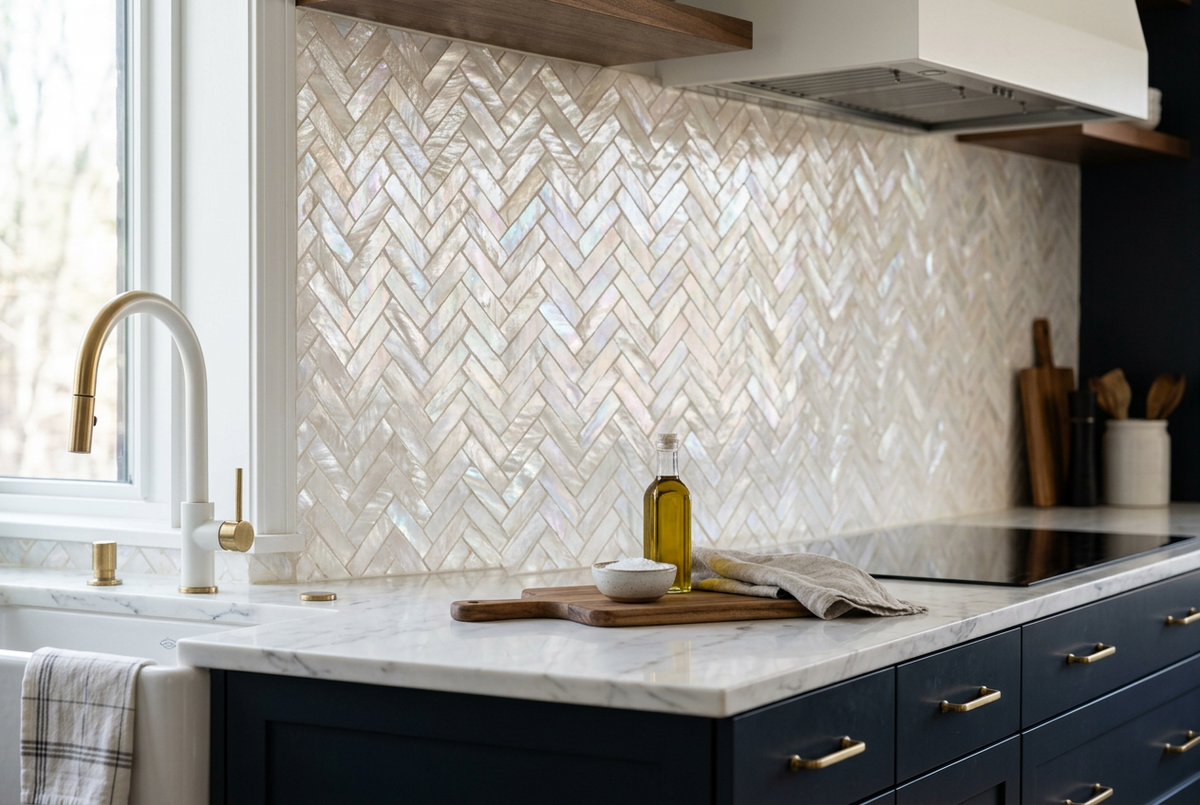
Most backsplash tile sits quietly behind your sink. Pearl tile does something different: it moves. The surface shifts from soft white to silver to blush as the light and your position change.
The short answer
Pearl tile backsplash is made from mother-of-pearl shell mounted on mesh sheets. It adds a soft, light-reflecting shimmer that ceramic and glass do not, and it works best on kitchen backsplashes, bathroom vanity walls, and accent walls. It is not meant for floors, and it needs gentler cleaning than porcelain. Choose a pattern (brick, herringbone, hexagon, fish scale, and more), decide between grouted and groutless sheets, and use non-abrasive care to keep the sheen.
Key takeaways
- Best for: backsplashes, vanity walls, fireplace surrounds, and accent walls
- Avoid: floors, high-abrasion surfaces, and acidic or scouring cleaners
- Look: iridescent and soft, with a sheen that changes through the day
- Grout choice: light, non-abrasive grout, or groutless sheets for a seamless look
- Budget tip: pearl is a premium finish, so using it as a focal zone is often smarter than covering every wall
What Is Pearl Tile?
Pearl tile, also called mother-of-pearl tile or pearl shell tile, is made from natural shell cut into small pieces and mounted on mesh sheets so it installs like a mosaic. The shell's layered surface bends light, which creates the pearly, almost liquid glow people notice. Because it is a natural material, the tone varies from piece to piece, and no two sheets look identical.
That glow is the reason pearl tile earns its place in a backsplash. It reflects light back into the room, which brightens a corner that ceramic would leave flat, and it pairs with nearly any cabinet color.
Is Pearl Tile Right for You? Three Quick Questions
Answer these before you pick a pattern.
1. Where will it go?
Great: backsplash, vanity wall, fireplace surround, accent wall, niche.
Not recommended: floors and anywhere shoes, chairs, or heavy objects will scrape it.
2. How do you clean?
Great: a soft cloth, mild pH-neutral cleaner, and a habit of wiping splashes.
Not recommended: scouring pads, acidic sprays, or heavy scrubbing.
3. What do you want it to do?
Great: add glow, brighten a dim corner, make a focal point.
Maybe pick something else: you want a tough, scrub-everything surface.
If you landed mostly on the "great" side, pearl is a strong fit. If not, a matte ceramic or porcelain backsplash may serve you better, and you can use pearl only as an accent strip.
Choose Your Pattern
Tile Hub's pearl shell range spans classic brick layouts to bold shapes. Each is shown once below, grouped by how much grout line you will see.
Traditional sheets (with grout lines)


Groutless sheets (tighter, seamless look)
Groutless pearl sheets set the pieces tightly together so the surface reads as one continuous shimmer. Ask your installer for guidance on joints and finishing for these sheets.


Pearl vs Other Backsplash Materials
General, relative guidance to help you compare. Exact performance varies by product.
| Factor | Pearl Shell | Ceramic / Porcelain | Natural Stone |
|---|---|---|---|
| Look | Iridescent, soft glow | Flat or glossy, uniform | Earthy, matte to honed |
| Light reflection | High | Medium (gloss) to low (matte) | Low to medium |
| Scratch tolerance | Lower, so clean gently | High | Medium |
| Cleaning | Soft cloth, mild cleaner | Forgiving | pH-neutral, sealing needed |
| Best role | Focal backsplash or accent | Whole-wall workhorse | Rustic or natural look |
Where Pearl Tile Looks Best
Kitchen backsplash
The classic use. Pair white pearl with dark cabinets for contrast, or cream pearl with wood. Wipe grease splashes promptly behind the range.
Bathroom vanity wall
A narrow band behind the sink or mirror adds glow without covering the room. Great under sconce lighting.
Fireplace and accent walls
A pearl surround turns light from a window or lamp into the star of the room.
Shower walls (with care)
Some homeowners use pearl on shower walls. Confirm suitability, sealing, and grout with your installer, and plan for gentle upkeep.
Cost: How to Budget for Pearl Tile
Pearl shell tile is generally a premium finish compared with basic ceramic, so budget for it as a feature. Prices vary by pattern, color, and sheet size, so check the current price on each product page. A few ways to keep the spend sensible:
- Make it the focal zone. Tile only the area behind the range or sink in pearl, and use simple ceramic elsewhere.
- Choose a simple pattern. Brick and square layouts usually involve fewer awkward cuts than herringbone or hexagon.
- Order extra. Add roughly 10% for cuts, and keep a few spare pieces for repairs.
- Plan labor. Small mosaic pieces take careful setting, so get a quote that accounts for cutting around outlets.
How to Install a Pearl Tile Backsplash
A typical sequence. Follow your tile maker's instructions for the specific sheets, and consider a professional for intricate patterns.
1. Prep
Clean, flat, dry wall. Protect counters and outlets.
2. Layout
Dry-fit sheets. Center the pattern on the range or sink.
3. Set
Use a light-colored thinset so the shell's glow is not dulled.
4. Cut
Use a fine-blade wet saw or nippers, and cut slowly to avoid chips.
5. Grout
Use non-abrasive grout where recommended, and test in a hidden spot first.
6. Finish
Wipe haze with a soft cloth, then caulk the counter joint.
Because sanded grout can scratch softer surfaces, many installers prefer a smooth, non-sanded option for shell tile. Confirm with your installer and the tile manufacturer before you start.
Care: Keep the Glow
Do
- Wipe splashes the same day
- Use a soft cloth or microfiber
- Use a mild, pH-neutral cleaner
- Rinse and dry to avoid streaks
Avoid
- Scouring pads and abrasive powders
- Vinegar, lemon, and other acidic cleaners
- Harsh solvents and bleach
- Heavy scrubbing at the grout lines
Before using any sealer or specialty cleaner on pearl shell, check the manufacturer's guidance, since not every product suits shell surfaces.
Frequently Asked Questions
What is pearl tile made of?
Pearl tile is made from natural mother-of-pearl shell cut into pieces and mounted on mesh sheets. The layered shell surface reflects light, which creates the iridescent shimmer.
Is pearl tile good for a kitchen backsplash?
Yes. It brightens the space and suits most cabinet colors. Wipe grease and splashes promptly and use a soft cloth with a mild cleaner to protect the surface.
Can pearl tile be used on a floor?
It is not recommended. Shell is softer than porcelain and can scratch under foot traffic. Use pearl on walls, backsplashes, and accent areas.
How do you clean a pearl tile backsplash?
Use a soft cloth or microfiber and a mild, pH-neutral cleaner, then rinse and dry. Avoid scouring pads, acidic cleaners like vinegar or lemon, and harsh solvents.
What is the difference between groutless and regular pearl tile sheets?
Regular sheets leave visible grout lines between pieces. Groutless sheets set the pieces tightly together, so the surface looks continuous. Ask your installer about joint finishing for the sheet you choose.
What grout color works with pearl tile?
A light or color-matched grout keeps the shimmer front and center. Dark grout creates a strong outline and can compete with the glow. Many installers prefer a non-abrasive grout for shell tile.